
BRIDS Market Pulse
In the Spotlight
Foreign inflows resume, albeit still narrow. The JCI rose 5.8% wow to 5,344.4, extending its recovery from the 3 November low to 9.0%. Auto (+15.8%) and Consumer (+13.6%) have led the recovery, followed by Banks, Cement, Metal and Telco. Meanwhile, Oil & Gas, Infrastructure and Healthcare remain below their 3 November levels. Foreign investors posted their first weekly net inflow since early September, concentrated in BBCA, ASII and BBRI, while the broader recovery remains largely domestically driven. With only a small portion of foreign selling since the MSCI announcement reversed, we see room for further selective inflows. Domestic funds’ reduced overweight in banks could also provide further support if foreign buying persists.
No negative surprises in index review, though freezes remain. The MSCI Nov26 review was broadly within expectations, with BRPT deleted from Standard and BRMS moved to Small Cap, while UNTR was retained. FTSE maintained Indonesia’s Secondary Emerging status but extended its restrictions on index changes until at least Mar27 and will remove HSC stocks in Dec26. While the review outcomes reduce some near-term uncertainty, the MSCI classification consultation remains unresolved. We expect active managers to remain the main potential source of incremental foreign demand. India’s US$6.9bn inflow over the past two weeks, against continued outflows in Taiwan and Korea, highlights Indonesia’s limited participation in the regional rotation.
Domestic: muted reaction to VP resignation; fiscal deficit remains contained. The market response to Vice President Gibran’s resignation was muted, with attention now shifting to the nomination of his successor and the MPR vote scheduled for 2 December. Indonesia’s fiscal deficit reached 1.47% of GDP in 10M26 (9M26: 1.24%; 10M25: 2.02%), as revenue growth (+23.9% yoy) continued to outpace expenditure growth (+15.6% yoy). Notably, Oct26 spending declined 7.7% mom despite a pick-up in central government spending (+4.6% mom).
Conditions for a sustained re-rating: broader inflows and Rupiah stability. Despite the equity rebound and resilient SBN demand, the rupiah weakened to Rp18,195/US$. Consensus expects BI to hold its policy rate at 5.75% this week with a hawkish bias, given rising US rate expectations. We see a risk to the consensus view should the Rupiah breach its recent low. We believe a broader recovery will require foreign buying beyond selected large caps, a more stable rupiah and greater clarity on fiscal financing. At 7.6x FY27F P/E, the JCI offers 12.3% upside to our end-2026 target of 6,000. We continue to favour selective exposure in our top picks: ASII, ADRO, AADI, BBNI, BRMS, INDF, AMMN, TINS, ISAT, DEWA, ELSA, GOTO, MIDI, MIKA.
Market and Sector Performance
The JCI closed at 5,344.4 (+5.8% wow, +294.0pts; -38.2% YTD). The biggest daily gain came on Thursday (+2.7%), following the MSCI review and coinciding with the Vice President’s resignation. The ADRO/AADI Rp66.8tr negotiated-market crossing on 10 November, involving the transfer of Adaro Strategic Investments’ stakes to four group shareholders, lifted reported average daily turnover to Rp23.7tr (+115% wow). Excluding the transaction, turnover fell 6% to c.Rp10.3tr. From 13 November, IDX excluded 383 HSC stocks from the JCI, up from 83. IDX market cap rose 3.5% to Rp9,047tr.
Regionally, Taiwan (+10.0%), Japan (+6.5%), Indonesia (+5.8%) and Korea (+4.6%) led, followed by Thailand (+2.7%), S&P 500 (+2.5%), UK and Dow Jones (+2.1%), Singapore (+1.0%) and India (+0.7%). China (-0.4%), Malaysia (-2.1%), the Philippines (-2.9%) and Hong Kong (-3.4%) fell. Indonesia remains the weakest market YTD (-38.2%), followed by China (-8.4%).
Across BRIDS coverage, Conglo (+10.1% wow), Auto (+10.0%), Technology (+9.2%), Heavy Equipment (+8.5%), Industrial Estate (+8.3%), Telco (+7.7%), Cement and Metal (+6.4%), Property and Banks (+6.1%) led. Coal (+5.8%), Media (+4.7%), Consumer (+4.4%), Tower (+4.3%), Utility (+3.5%), Poultry (+3.1%), Cigarettes (+2.5%), Pharmaceuticals (+2.1%), Retail (+1.4%) and Oil & Gas (+0.2%) also rose. Infrastructure (-1.8%) and Healthcare (-3.6%) fell.
Since the 3 November low, Auto (+15.8%), Consumer (+13.6%), Banks (+12.4%), Cement (+12.3%), Metal (+12.1%), Telco (+11.9%), Utility (+11.0%) and Media (+10.6%) have outperformed the JCI (+9.0%). Heavy Equipment (+7.8%), Property (+7.0%), Technology (+6.6%), Pharmaceuticals (+6.4%), Industrial Estate (+5.9%), Conglo (+5.3%), Coal (+4.4%), Cigarettes (+4.0%), Tower (+2.8%) and Retail (+2.4%) lagged. Poultry (-0.6%), Oil & Gas (-2.1%), Infrastructure (-2.2%) and Healthcare (-5.4%) remain below their 3 November levels.
Equity Foreign Funds Flow
IDX recorded net foreign buying of Rp463bn across all markets, reversing the previous week’s Rp167bn outflow. Regular-market inflows totalled Rp619bn, taking November MTD net selling to Rp69bn. YTD net foreign selling stood at Rp97.6tr.
Inflows: BBCA (+Rp866bn), ASII (+Rp531bn) and BBRI (+Rp392bn) accounted for Rp1.79tr of net buying, against net selling of Rp1.17tr across the rest of the regular market. INKP (+Rp55bn), BUMI (+Rp54bn), EXCL (+Rp51bn), TINS (+Rp43bn) and PGAS (+Rp40bn) followed. BBCA recorded its third consecutive weekly inflow, while BBRI recorded its first in six weeks.
Outflows: BRPT (-Rp186bn), BREN (-Rp143bn), TLKM (-Rp131bn), GOTO (-Rp122bn), JPFA (-Rp94bn), RAJA (-Rp91bn), INCO (-Rp73bn), AADI (-Rp59bn), ANTM (-Rp58bn), AMMN and BBNI (-Rp54bn each). Coal outflows moderated to Rp58bn across AADI, ADRO, ITMG and PTBA as ADRO and PTBA turned to inflows. BRPT and RAJA were sold ahead of MSCI deletions, while BREN is already outside MSCI, FTSE and the JCI. BRIS recorded a small Rp20bn inflow despite its upcoming FTSE deletion.
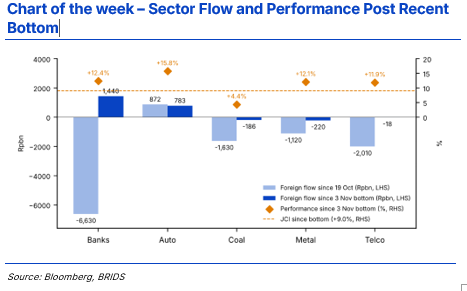
Rebound since the 3 November low. Across our coverage, foreigners have bought a net Rp1.75tr from 4 to 13 November (Rp1.39tr including 3 November), compared with cumulative net selling of Rp10.84tr since 19 October. Banks led with Rp1.44tr of inflows since 3 November, against Rp6.63tr of cumulative selling since 19 October. Auto recorded Rp783bn of inflows since the low and Rp872bn since 19 October, the only coverage sector with net inflows over the latter period. Coal (-Rp186bn), Metal (-Rp220bn) and Telco (-Rp18bn) continued to see outflows since 3 November.
BBCA (+13.6%; Rp1.53tr foreign inflow), ASII (+15.8%; Rp736bn) and BBRI (+15.0%; Rp262bn) rallied with foreign support over 4 to 13 November. In contrast, TLKM (+14.9%), BMRI (+8.4%), BBNI (+10.3%), ICBP (+18.6%), ANTM (+17.1%) and INCO (+18.3%) rose despite net foreign selling, suggesting stronger domestic support. Consumer, Metal and Telco similarly rallied with limited foreign participation.
Regional flows. India attracted US$3.3bn, bringing its two-week inflow to US$6.9bn, while Indonesia received US$25mn. Taiwan (-US$2.9bn), Korea (-US$237mn), Brazil (-US$207mn), Malaysia (-US$87mn), Vietnam (-US$29mn), Thailand (-US$25mn) and the Philippines (-US$5mn) saw outflows. YTD outflows remain concentrated in Korea (-US$149.4bn), Taiwan (-US$87.3bn) and India (-US$22.0bn), followed by Indonesia (-US$5.6bn) and Vietnam (-US$4.6bn). Brazil (+US$5.8bn) and Thailand (+US$0.4bn) remain net recipients.
Index Reviews and Domestic Policy
MSCI November review. BRPT was removed from MSCI Standard Index, BRMS was moved to Small Cap and seven names were deleted from Small Cap (AVIA, CTRA, MTEL, EMTK, JSMR, RAJA and WIFI), effective after the 30 November close. No new Indonesian names were added and seven Standard constituents remain. UNTR was retained, despite our earlier assessment of its deletion risk. The stock rose 8.5% wow and recorded a small Rp3bn foreign inflow, reversing the previous week’s Rp77bn outflow. The existing MSCI freeze remains in place until further notice, with Indonesia’s proposed reclassification to Standalone still under consultation.
FTSE December review. FTSE retained Indonesia’s Secondary Emerging status without placing it on the Watch List. Restrictions on new additions, free-float increases and most size-segment changes remain until at least the Mar27 review. FTSE will also remove affected HSC securities at market prices, effective 21 December. Based on the current list, 14 Indonesian constituents are affected, including BRIS, MTEL, TBIG, MAPI, TKIM and nine Micro Cap names. The restrictions limit new passive allocations through additions and free-float increases, but remaining constituents may still see weight changes from index rebalancing.
Vice President succession. Gibran Rakabuming Raka submitted his resignation on 12 November. The President must nominate two candidates and the MPR has scheduled its plenary vote for 2 December, within the constitutional 60-day period. Coalition leaders met the President in Bogor on 13 November, with no candidates announced. The JCI rose 2.7% on the day of the resignation, while the rupiah weakened. We will monitor the succession process but expect no changes on policy and the 2027 budget.
Bonds, Rupiah and Macro
Fiscal. Indonesia’s fiscal deficit reached 1.47% of GDP in 10M26 (9M26: 1.24%; 10M25: 2.02%), as revenue growth (+23.9% yoy) continued to outpace expenditure growth (+15.6% yoy). Notably, Oct26 spending declined 7.7% mom despite a pick-up in central government spending (+4.6% mom). While the government maintains its FY26 deficit outlook of 2.85% of GDP, this would require monthly spending in Nov-Dec26 to accelerate from Oct26 levels. Thus, we see scope for a deficit undershoot, potentially easing near-term fiscal concerns, albeit with a more limited fiscal impulse to 4Q26 growth.
Bonds. The 10Y SBN yield eased 5bps wow to 7.64%, despite a rise in the 10Y UST yield to 5.14% from 4.86%, narrowing the spread to c.250bps. Foreign investors bought Rp4.7tr of SBN through 11 November (Rp43tr YTD) but sold Rp3.7tr of SRBI MTD. The Finance Ministry indicated remaining financing requirements of Rp202.9tr across five auctions, with the 10Y SBN yield above the 6.9% budget assumption.
Rupiah and US rates. The rupiah weakened 0.5% wow to Rp18,195/US$ (-8.3% YTD), after touching Rp18,232 on Thursday. US October headline CPI rose 0.4% mom (consensus: 0.3%), with core at 0.3%. Markets have nearly fully priced a December Fed hike, with the probability of a 50bps increase rising to c.11-15%. The stronger dollar outweighed the benefit of lower oil prices for the rupiah this week.
BI outlook (17-18 November RDG). Consensus expects BI to hold the BI Rate at 5.75%, with a hawkish bias. BI raised its Deposit Facility rate to 5.00% in October and we expect it to continue relying on intervention and SRBI. The risk of a hike would increase if the rupiah comes under further pressure ahead of the December FOMC.
Valuation. Based on FY27F EPS of 706, the JCI trades at 7.6x P/E, equivalent to a 13.2% earnings yield. The spread over the 10Y SBN narrowed to c.557bps from c.629bps last week, largely reflecting the equity rebound. We maintain our end-2026 JCI target of 6,000, implying 12.3% upside.
War Watch
Brent fell for a second week despite continued disruptions to shipping and threats to Saudi oil infrastructure. Iran submitted a proposal through Qatar to reopen Hormuz, but President Trump indicated on 12 November that the US could continue relying on economic pressure and its blockade. The Houthis claimed strikes on Saudi oil facilities, including the East-West pipeline and Yanbu, while Iran reported explosions on four tankers in Hormuz. The claims remain subject to verification.
The IEA expects the global oil market to return to a surplus of 1.7mn bpd in 4Q26, with OPEC+ output rising in October. We believe expectations of easing supply tightness are increasingly offsetting geopolitical risk. Lower crude prices should ease Indonesia’s oil import and subsidy bills, although renewed supply disruptions remain a risk.
Commodity Prices
Thermal coal. ICI-3 edged up to US$101.7/t from US$101.2/t and ICI-4 to US$79.3/t from US$79.2/t, while Newcastle futures fell 2.3% wow to US$142.1/t. China port inventories rose c.5% wow (Exhibit 10).
Chinese demand remains subdued ahead of the peak winter season. Downstream inquiries at northern ports were limited, while mine-mouth prices were rangebound amid delayed restocking and weaker non-power demand. CCI 5500 fell to CNY1,017/t on 30 October, from CNY1,040/t a week earlier. Power plants held 210Mt (35 days of cover) on 25 October,close to the three-year average, while coal-fired generation fell 1.9% yoy in Sep26. Oct26 coal imports fell 5.5% yoy and 9.1% mom to 39.4Mt, with 10M26 imports of 393Mt (+1.4% yoy). Seaborne thermal coal arrivals remained near 24Mt, although Indonesian arrivals increased to 14.1Mt from 13.2Mt.
We view the recent price resilience as more supply driven. Chinese output fell 3.5% yoy to 3.45bn tonnes in 9M26, while safety inspections continue to limit restarts in Shanxi. Chinese buyers are reportedly resisting contractual waivers sought by Indonesian suppliers to cover potential export or quota restrictions. Potentially higher Indonesian FY27 quotas could limit pricing power unless winter restocking picks up.
Base metals. LME copper cash fell 2.5% wow to US$13,610/t, its fifth consecutive weekly decline. A stronger US dollar, concerns over AI capex and a potential unwind of US tariff-related stockpiling weighed on sentiment. COMEX inventories reached c.732kt, while LME stocks rose to 329.1kt on 13 November, from 316.6kt on 10 November. Conversely, SHFE stocks fell 18.3% wow to 27,642t, their lowest since December 2023, and the Yangshan import premium reached US$285/t. Chinese smelters continue to face negative treatment charges. We view the divergence as evidence of tighter physical conditions in China, which could provide some support against financial selling and weaker US demand for inventories. LME nickel was broadly flat at US$16,025/t (-0.4% wow), while tin rose 4.3% to US$48,295/t on lower stocks and wider backwardation. NPI and MHP were broadly stable (Exhibits 17 and 18).
Oil. January Brent settled at US$95.84/bbl (-2.5% wow), after briefly trading below US$90/bbl midweek. Supply expectations have offset much of the geopolitical risk premium (see War Watch).
Gold: speculative liquidation, with room for further selling. Spot gold fell c.4.5% wow to c.US$3,880/oz, touching US$3,852 on Thursday, its lowest since Oct25. Higher US rate expectations and the stronger dollar weighed on prices.
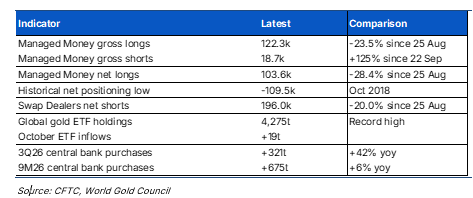
- Between 25 August and 3 November, gold fell 16% and COMEX Managed Money net longs fell 28% from c.145k to 104k contracts. About 91% of the reduction came from long liquidation, although gross shorts more than doubled from 8.3k to 18.7k contracts since late Sep26. Net longs remain near the 49th percentile of their historical range since 2006, well above net-short troughs in October 2018 (-109k contracts) and September 2022 (-43k). Swap Dealers reduced net shorts by 20% to 196k contracts. Positioning therefore does not yet indicate capitulation.
- Physical demand. Physically backed gold ETFs added 211t in 3Q26 and 19t in October, supported by European and Asian demand, with global holdings at a record 4,275t. North American flows were weaker and GLD recorded c.US$1.5bn of outflows over the past 30 days. Retail demand was softer, with bar and coin demand down 19% yoy and jewellery demand down 17% yoy in 3Q26.
- Central banks. Estimated net purchases reached 321t in 3Q26 (+42% yoy), taking 9M26 purchases to 675t (+6% yoy). China and Poland were among the largest reported buyers, while Russia was a net seller. China added c.26t in October, extending its buying streak to 24 months. Reporting lags limit visibility on more recent official transactions.
- Our view. Official demand remains supportive, but we remain tactically cautious given higher US rate expectations, a stronger dollar and scope for further speculative liquidation. A more constructive signal would be price resilience despite continued liquidation. Conversely, broader ETF redemptions, increased short selling and slowing central bank demand would suggest a more fundamental weakening.
Week Ahead: Key Catalysts
- 17-18 November: BI RDG. Consensus expects a hold at 5.75% with a hawkish bias.
- 18 November: LQ45 and IDX80 changes effective. LQ45 additions: ERAA, GGRM and PWON; deletions: MAPI, NCKL and PGEO.
- Throughout the week: Vice President nominations, foreign flow breadth, Rupiah, and updates on oil supply flows.
Further out: MSCI changes effective 1 December (30 November close); MPR vote on VP on 2 December; FOMC 8-9 December; BI RDG 15-16 December; FTSE HSC deletions effective 21 December; MSCI February review announcement on 9 February 2027.
BRIDS Key Research Reports
Our Key Picks: ASII and UNTR
Astra International (ASII, Buy, TP Rp6,950). ASII rose 10.0% wow and 15.8% since the 3 November low, supported by Rp531bn of weekly foreign inflows. Our positive view rests on capital discipline and resilient earnings despite 4W market share pressures. In 3Q26, 4W distribution margin recovered to 2.4%, while 2W and component earnings rose 18% and 34% yoy, respectively. UNTR remains the main earnings growth driver into FY27. At Rp5,500, ASII trades at 6.7x FY27F P/E with a c.10% FY26F dividend yield and 26% upside to our TP.
United Tractors (UNTR, Buy, TP Rp27,700). Retention in MSCI Standard removes an immediate index deletion risk. We expect operational recovery to continue, supported by the upward revision in coal production RKAB to 700Mt from 600Mt and PAMA’s FY26 overburden guidance to 1,025mn bcm. Martabe gold sales have resumed following its May restart, with a tailings permit expected this month. We retain our more conservative 21% gross margin assumption for FY27-28F, following 9-18% earnings cuts in our latest update. At Rp24,975, UNTR offers 11% upside to our TP.
Post-results Notes
BBRI (Not Rated): 3Q26 net profit rose 16% yoy as lower provisions (CoC -108bps qoq to 2.3%) and stronger non-interest income offset a 74bps qoq NIM decline to 6.8%. Micro loans grew qoq for the first time since Dec24.
PGAS (Buy, TP Rp1,900 unchanged): 9M26 net profit rose 16% yoy, above our forecasts, supported by a higher-than-guided trading spread (US$1.93/MMBtu). We raised FY26-28F earnings by 21-35%. The LNG price cap and Gunvor dispute remain key risks.
SILO (Buy, TP Rp2,500 from Rp2,850): 3Q26 net profit rose 14% yoy on better volumes and revenue intensity. We cut FY26-27F earnings by 7-17% on higher financing costs following the REIT transaction.
ICBP (Buy, TP Rp9,200 from Rp10,600): Volume-led 3Q26 growth (noodles +12%, dairy +27% yoy) supported an increase in FY26 revenue growth guidance to 12-14%. However, gross margin declined to 33.7%, prompting c.4-5% core profit cuts.
ELSA (Buy, TP Rp1,000 from Rp1,110): 9M26 net profit rose 29% yoy on energy distribution growth and lower costs, with Rp20.4tr of carry-forward backlog. Fuel costs remain a margin risk and the TP cut reflects a higher WACC.
TOWR (Buy, TP Rp540 from Rp610): Tower revenue is stabilising following EXCL repricing, but a 70bps qoq increase in cost of debt prompted 4-8% cuts to FY26-28F earnings.
… Read More 20261116 BRIDS Market Pulse