
BRIDS Market Pulse
In the Spotlight
- Market and Sector Performance
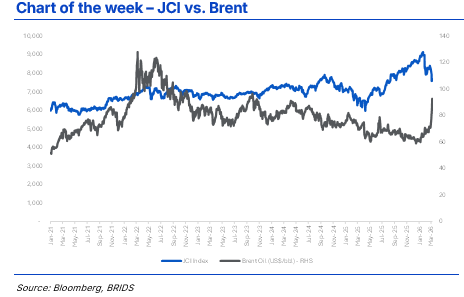
JCI edged down –0.1% w-w to 7,107 as of 27 March, its first trading week post-Eid, bringing YTD performance to –17.9%, the worst among EMs. The week saw a two-way tape, with 12 of 22 BRIDS sectors posting positive returns. Top-performing sectors were energy related with Oil & Gas (+4.0%), Coal (+3.5%), Heavy Equipment (+2.0%), followed by Auto (+5.6%) and Poultry (+5.4%). On the downside were Banks (–1.4%), Metal (–1.9%), and Consumer (–1.8%). Index movers show ASII, MEGA, AMMN, ENRG, and DSSA as the top positive contributors, while EMAS (–10.5%), BREN (–4.7%), BBRI (–1.7%), DCII (–4.2%), and BBCA (–1.1%) were the key drags.
- Regional Markets
Regional markets delivered a strong week despite ongoing geopolitical risks. KOSPI gained +1.9% w-w, Taiwan +4.4%, Hong Kong +2.1%, and India +3.6%. S&P 500 rose +4.5% and NASDAQ surged +6.6%, as investors appeared to price in a tentative diplomatic track on the Iran conflict. Japan gained +0.7%, Singapore +0.3%, while Thailand (–1.4%) remained the notable underperformer. JCI's –0.1% decline was modest relative to the broader regional rally, suggesting ongoing domestic headwinds from foreign outflows, notably with sell-down in banks.
- Foreign Flows
The fourth week of March saw continued foreign selling pressure on Indonesian equities, with US$1,322mn. YTD cumulative outflows remain elevated at approximately US$1,832mn. Regional EM flows were mixed during the week, with India, Taiwan, and South Korea continuing to see large outflows amid war-driven risk-off sentiment.
- War Watch: US–Iran Conflict Day 28–29
- The conflict has now entered its 29th day. The most significant development this week was Trump's extension of the pause on strikes against Iranian energy infrastructure by an additional 10 days, pushing the deadline to April 6th. The White House described peace talks as going "very well," though Iran rejected the characterization, with Foreign Minister Araghchi stating that no negotiations have taken place.
- On the ground, hostilities intensified. An Iranian missile and drone strike on Prince Sultan Air Base in Saudi Arabia on 27 March. On the same day, Israel struck the Shahid Khondab heavy water reactor in Arak and the Ardakan yellowcake plant in Yazd Province. The Houthis also formally entered the war on 28 March, launching a ballistic missile toward Israel.
- The Strait of Hormuz remains effectively closed to commercial traffic since 2 March though Iran has begun operating a yuan-denominated toll mechanism on select vessels. The Iranian parliament is reportedly preparing legislation to formalize transit fees. Key triggers to monitor include: the April 6 deadline for energy strikes, the outcome of mediation efforts through Pakistan and Turkey, and whether shipping through Hormuz shows any signs of normalization.
- Indonesia Policy Response Updates
- WFH 1 day/week formal announcement imminent. On 27 March, Coordinating Economic Minister Airlangga Hartarto confirmed that the government will implement mandatory WFH for ASN every Friday, with advisory application for the private sector. The policy targets minimal productivity disruption given shorter Friday working hours. Meanwhile, the government scrapped the April 2026 online schooling plan. We see this as a constructive signal on policy calibration.
- Fiscal resilience narrative maintained. The government continues to downplay energy shock risks, with Finance Minister Purbaya reiterating that the 2026 APBN (ICP assumption: US$70/bbl) remains manageable despite current oil levels. The policy mix suggests a preference for incremental adjustments over broad-based intervention, though fiscal sensitivity to oil remains a key risk.
- Commodities
- Energy: Brent crude surged +9–10% w-w from US$103/bbl to settle at US$112.6/bbl on 27 March, the highest since mid-2022, reflecting renewed escalation fears after the Prince Sultan Air Base attack and Houthi entry into the war. The EIA's March outlook projects Brent above US$95/bbl through May 2026, averaging US$91/bbl in 2Q26 before easing below US$80/bbl in 3Q26, contingent on Strait of Hormuz reopening, which appears increasingly uncertain. The April 6 deadline for energy infrastructure strikes is the next major price catalyst.
- Gold stabilized at US$4,434/oz, recovering modestly from the prior week's sharp –12% selloff. Safe-haven demand remains structurally supported, though USD strength and elevated real yields continue to cap upside.
- Thermal Coal:
- ICI prices mixed; high-CV demand holds. ICI-3 rose to US$74.5/t while ICI-4 softened to US$59.5/t, reflecting continued preference for higher-CV coal amid LNG disruption and oil/ gas-to-coal switching. Both indices remain well above Jan-26 levels, supported by ongoing dislocation in global gas markets.
- RKAB policy shifting toward conditional flexibility, export tax is a risk. Pre-Eid, Coordinating Economic Minister Airlangga Hartarto signaled a potential increase in 2026 coal output via RKAB revision, reversing the earlier plan to cut national quota from 790mt (2025) to 600mt (2026), in response to stronger regional demand. However, by 27 March, ESDM Minister Bahlil clarified that no formal revision has been issued, with production to be adjusted in a measured, price-dependent manner. In effect, we view the 600mt level is no longer a hard cap, but with policy calibrated to balance price support and supply response. We see this as modestly positive for coal names (PTBA, ADRO, ITMG, AADI), providing upside production flexibility if prices remain elevated, though potential export tax remains a key risk.
- Base metals remained under pressure amid USD strength and broader risk-off in EM. Nickel traded at US$16,900–17,400/t, broadly flat to slightly weaker w-w, with concerns over demand destruction offsetting support from Indonesia's RKAB-related supply constraints. Copper also eased from recent highs on softer demand outlook.
- Week Ahead: Key Catalysts (30 Mar – 4 Apr 2026)
- War triggers & oil. The key macro catalyst remains the 6 April deadline for Iran to reopen the Strait of Hormuz, with risk of escalation if talks fail. Markets may focus on progress in Pakistan-mediated US–Iran discussions, further Houthi escalation, and any signs of tanker flow normalization.
- Earnings season (4Q25). 4Q25 results will be in full swing, with results announced thus far have been broadly constructive for consumer companies (reflecting the pre-war conditions). CPIN and MIDI delivered strong beats on margin expansion and cost efficiency, MYOR showed sequential recovery with improving margins, while UNVR continued volume recovery though FY25 came slightly below expectations. Focus will shift to sustainability of margins into FY26 amid rising input and macro volatility.
- Policy watch. Near-term triggers: a) WFH rollout, b) fuel supply c) fuel subsidy/ pricing d) coal export tax + RKAB details.
- JCI reform progress. Focus remains on deliverables ahead of MSCI May 2026 review. Key near-term milestones include shareholder concentration disclosure and granular investor data (targeted end of March/ early April). Investors will also watch progress on the 15% free float rule and any signals from FTSE Russell ahead of its May review.
- CPIN (Buy, TP raised to Rp5,900) – FY25 Earnings beat on robust margin; gearing up for a robust 1Q26. CPIN booked net profit of Rp2.3tr in 4Q25 (+56% qoq, +72% yoy), bringing FY25 NP to Rp5.6tr (+ 52% yoy), above our and consensus est. The strong earnings was driven by higher qoq OPM across segments (except feed), normalized tax rate, and lower gearing despite inventory build-up. We maintain Buy rating with a higher TP of Rp5, 900 as we revise FY26F EBITDA up by 11%, with robust 1Q26 earnings as a near-term catalyst.
- GOTO (Buy, TP lowered to Rp80) – GTF growth to drive upside, but Grab’s recent deal may imply lower merger possibility. Disciplined promotions drove GOTO’s FY25 ODS margin to 2.1% (+100bps yoy), while mass market monetization remains in progress. We see robust FY26 GTF guidance (Rp1.4–1.5tr/ +182–202% yoy) as key to delivering group adj. EBITDA targets at Rp3.2-3.4tr. We maintain Buy but lower TP to Rp80. Despite our higher earnings outlook, we see Grab’s Foodpanda deal may lower merger odds and cap takeover premium valuation.
… Read More 20260330 BRIDSMarketPulse