
BRIDS Market Pulse
In the Spotlight
Market and Sector Performance. JCI rose 1.93% wow to 6,525.69, its best weekly gain in five weeks, with the advance broadening beyond the commodity and small cap names that had carried the index through Jul26 and early Aug26. The rupiah strengthened in step, ending at Rp17,693/US$ from Rp17,825, a 0.74% wow gain. We view the week as constructive as the rally finally showed broader support from banks, while the Data Center theme extended from telco into second order beneficiaries, namely industrial estate landlords and telco towers.
Banks supplied the broader leadership the market had been missing. All four large cap banks ranked among the week's top ten index point contributors. The combined contribution of around 32 points was larger than BYAN's 19.7 point single name contribution. This was the first week since BI succession clarity emerged that bank leadership appeared at this scale, supported by the second consecutive BI rate hold and continued 10Y SBN yield compression.
The Data Center theme moved from telco into property and infrastructure. Industrial estate landlords with direct data center land bank exposure rallied, with DMAS up 12.08% wow and SSIA up 6.29%. DMAS's Kota Deltamas estate sits inside the GIIC industrial park, which hosts several large foreign backed data center pipelines named in our Telco sector report, while the company's disclosures show that more than 70% of 2026 industrial land absorption came from data center tenants, driving 1H26 net profit up 175% yoy. Tower names also picked up, with TOWR up 11.28% wow and TBIG up 3.94%, both appearing in this week's top 20 foreign net buy list.
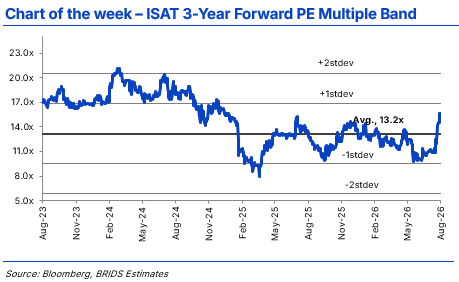
The market was still selective within the theme. ISAT extended its Zankore driven rally by 7.09% wow and added 2.2 index points, although foreign buying remains absent. TLKM lagged at minus 0.38%, while DCII, the largest pure play data center operator outside BRIDS coverage, was among the larger point detractors. We think the market is rewarding names with live near term optionality, such as Zankore's formal structure and DMAS's land monetisation, over names viewed as already priced in.
Gold and copper linked miners moved on a separate dollar driven thread. BRMS rose 12.10% wow, the largest single Metal Mining contribution. AMMN, EMAS also tracked gold's move to above US$4,500/oz and LME copper squeeze near US$14,290/t. Within the coal and energy names, AADI rose 3.98%, HRUM 8.24% and ADRO, ITMG and PTBA were broadly flat, tracking the firm but less directional thermal coal prices. By IDX sector, Basic Material led at +3.7%, followed by Energy at +2.9%, Infrastructure and Properties and Real Estate at +2.7%, and Consumer Non Cyclical at +2.3%. Healthcare was the only sector in the red, down 0.5%.
We maintain our Dec26 JCI target of 7,200, implying 10.3% upside from current levels. With the index up 1.9% wow, forward valuation moved to around 9.8x, or a 10.2% earnings yield, absent fresh bottom up EPS revisions this week. The 10Y SBN yield continued to compress from 7.20% on Tuesday to 7.07% by Thursday, with Friday's close not yet confirmed in our data, narrowing the implied earnings yield spread to around 3.1ppt from 3.3ppt last week.
Foreign Flows
Indonesia recorded a WTD inflow of US$126.0mn as of 21 Aug, reversing last week's modest outflow. India led with US$293.7mn, while Taiwan recorded US$21.3mn. South Korea reversed to a US$1.60bn outflow after last week's US$5.44bn inflow, while Brazil saw a further US$743.9mn outflow. On a YTD basis, Indonesia's cumulative foreign outflow narrowed to US$4.08bn from US$4.21bn last week.
Foreign trading in the regular market opened the week with net selling of Rp689.3bn on Tuesday and Rp488.5bn on Wednesday, before turning to net buying later in the week.
Buying was led by BBRI at Rp750.4bn, BBCA at Rp406.3bn, AMMN at Rp333.9bn, ANTM at Rp251.0bn and PSAB at Rp137.9bn. Selling was concentrated in TPIA at Rp63.3bn, UNTR at Rp59.9bn, EMAS at Rp54.9bn and BREN at Rp51.9bn. Notably, several of the week's best performing property names, including PWON and BSDE, saw net foreign selling despite price gains. This suggests the property and data center adjacent rally remains more domestically driven than foreign led for now.
Index Movers
BYAN remained the dominant single contributor, adding 19.7 index points on an 8.33% gain, but this week's advance had broader support than in recent editions. BBRI added 16.1 points, BRMS 11.2 points, AMMN 8.9 points and BBCA 8.9 points, followed by BUMI, BMRI, DSSA and BBNI.
On the downside, BREN was the largest drag, removing 4.3 points on a 3.08% decline, followed by SRAJ, MPRO, TCPI and CASA. DCII removed 2.4 points and was the notable data center name on the detractor side, reinforcing our view that the theme is becoming more selective.
Sector and Coverage Performance
By IDX sector, Basic Material led at +3.7%, followed by Energy at +2.9%, Infrastructure and Properties and Real Estate at +2.7%, Consumer Non Cyclical at +2.3%, Industrials at +1.7%, Transportation and Logistics at +1.4%, Consumer Cyclical at +1.2%, Financials at +1.0% and Technology at +0.8%. Healthcare was the only sector in negative territory, down 0.5%.
Across BRIDS coverage, Industrial Estate led at +9.13%, driven by DMAS and SSIA, followed by Media at +7.19%, Tower at +5.29% and Metal Mining at +5.09%. Property, Oil and Gas, Heavy Equipment and Coal also outperformed. Poultry was the weakest sector at minus 2.40%, tracking JPFA's sharp 2Q26 livebird margin normalisation, followed by Utility and Technology.
Indonesia Policy and Macro
BI held its policy rate at 5.75% for a second consecutive meeting at the 19 to 20 Aug RDG, alongside the Lending Facility and Deposit Facility rates at 6.50% and 4.75%. The hold points to a shift toward targeted monetary incentives and SRBI yields to attract foreign inflows and support the rupiah, rather than further policy rate tightening. Macroprudential policy remains pro growth, with the focus on liquidity transmission and lending.
BI also reported Q3 foreign portfolio inflows of US$1.8bn through 14 Aug, supported by global bond issuance and SBN and SRBI purchases. We view this as a constructive external financing signal, especially alongside the rupiah's strength this week.
2Q26 current account deficit widened sharply to 3.30% of GDP (US$12.5bn) from 1.09% of GDP (US$3.6bn) in 1Q26. The deterioration was driven by a steep narrowing of the trade surplus to US$1.32bn from US$10.52bn a year earlier, reflecting an oil-import surge amid Middle East tensions, alongside a wider services deficit (US$5.98bn from US$5.30bn). The overall Balance of Payments still improved to a smaller US$0.9bn deficit (from Q1's US$9.1bn), as the capital and financial account posted a US$12.0bn surplus on higher direct and portfolio investment inflows; external financing covered the wider current-account gap this quarter, but the underlying deterioration directly reinforces the macro sensitivity RAPBN 2027 flagged last week.
War Watch
Brent extended its advance to around US$93.9 to 94.2/bbl from around US$88.5/bbl last week, a second consecutive weekly gain of roughly 6%, driven by escalation. Treasury Secretary Bessent said the US would announce its toughest ever sanctions on Iran on Monday 24 Aug, with President Trump describing the measures as an economic D Day. The shift from last week's Iran Oman Hormuz transit talks to a fresh sanctions push keeps Indonesia's fuel subsidy, inflation and BI policy calculus exposed to headline risk.
Global
The dominant global story was Treasury Secretary Bessent's debt buyback expansion. On 19 Aug, Treasury said it would at least double the size of buyback operations for 10Y to 30Y securities, from a US$2bn to a US$4bn plus per operation ceiling, effective 9 Sep through November. The aim is to support liquidity in a 30 year sector the Treasury described as thin. The move came against a backdrop of US national debt crossing US$40tr, a widening fiscal deficit and heavy AI and data center related corporate bond issuance competing with Treasuries for demand.
Yields initially fell sharply after the announcement, with the 10Y down 5.7bps to 4.647% and the 30Y down 9bps to 5.196%, but both fully reversed above pre announcement levels by Thursday. Bessent then reiterated that the US$4bn figure was a floor rather than a ceiling. The USD weakened over the week alongside the initial yield move. This happened despite Brent's roughly 6% rally, which would normally support the dollar through safe haven and oil importer demand. The Treasury buyback and yield credibility story dominated FX flows this week, rather than oil.
Gold moved higher on the same weaker dollar reaction, layered on top of the central bank buying support story. Silver moved in tandem, clearing US$68/oz.
Commodities
Thermal coal held broadly flat wow, with ICI-3 and ICI-4 unchanged at US$83.6/t and US$64.6/t, while Newcastle was little changed at around US$130.2/t. Chinese port inventory continued easing to 2,298.9 from 2,342.9 last week, moving further into the five year average band. This reinforces our view that Indonesian coal remains more quota constrained than demand constrained.
Base metals were broadly firmer. LME copper rose to around US$14,290/t on continuing backwardation driven tightness. LME nickel firmed modestly to around US$17,000 to 17,045/t. LME tin extended its rally sharply to around US$55,500 to 55,800/t from US$51,000 to 52,000/t last week. Recent news flow links the move to AI and data center solder demand, alongside continued tight Indonesian export licensing.
Gold touched around US$4,520/oz from US$4,365 last week, up roughly 3.5% wow, on the weaker dollar reaction to the Bessent buyback story. Silver firmed to around US$68 to 69/oz from US$64 to 65.
NPI, Indonesia Ni above 14%, held broadly flat at around US$153 to 154/mtu. MHP closed at US$14,878/t, down from US$15,024/t last week.
BRIDS Key Research Reports
Telco sector (maintain OW) – A Look at Data Center Growth Potentials. Indonesia's installed data center IT capacity stood at around 580MW in 1H26, with 55% in Jakarta, and is projected to reach 3.5GW by 2030, a 56.7% CAGR. Growth is driven by AI and cloud demand, plus regional spillover as Singapore rations capacity and Johor faces power constraints.
Jakarta carries a 5.3x pipeline to operational ratio, with 1.7GW pipeline capacity versus 322MW live. Batam adds a 1.4GW pipeline on a 126MW base and is more hyperscale and AI anchored, with 71% hyperscale exposure and foreign led demand. Jakarta remains more domestic and cloud skewed.
The largest committed pipelines remain foreign backed, including DAMAC, Princeton Digital, ST Telemedia, DayOne and EdgeConneX. Among listed names, TLKM remains Buy with TP raised to Rp3,650 from Rp3,500. NeutraDC's planned 70% stake divestment at a US$1.0 to 1.5bn valuation implies 4.5% TP upside. ISAT remains Buy with TP Rp2,500 and potential re rating to Rp3,350, as its 30% Zankore neocloud stake could imply a 35% uplift to equity value once formalised. DSSA and DCII, both Not Rated, offer more direct exposure via SM+ and DCI's 128MW live base with the more than 1,000MW Bintan optionality. MGLV, INET and BNBR are earlier stage names to monitor.
Post 2Q26 earnings notes
ICBP, Buy maintained, TP raised to Rp10,600 from Rp10,500. 1H26 revenue grew 11.3% yoy, led by overseas noodles and dairy. FY26 and FY27 earnings were raised by 6.2% each.
JPFA, Buy maintained, TP unchanged at Rp3,300. 2Q26 was in line and 1H26 net profit doubled yoy, although 2Q26 margin normalised sharply on weaker livebird prices.
DEWA, Buy maintained, TP cut to Rp530 from Rp550. 2Q26 EBITDA margin improved on the Bengalon ramp up, while the TP cut reflects front loaded FY26F capex.
TINS. 1H26 operational comeback beat expectations, with firm ASP expected to support 2H26 earnings.
Weeks Ahead: Key Catalysts
US sanctions on Iran, Mon 24 Aug. Treasury Secretary Bessent said details of new US measures to isolate Iran's economy would be announced Monday. Watch scope, especially China exposure as Iran's largest crude buyer, and the follow through to Brent after a second straight weekly gain of around 6%.
US PCE inflation, Jul26, Wed 26 Aug. The Fed's preferred inflation gauge lands mid way through Jackson Hole week. A soft print would reinforce the dovish lean from the Treasury buyback narrative, while a hot print would clash with it and risk another yield reversal.
Jackson Hole, 27 to 29 Aug. The key question is whether Fed Chair Warsh's hawkish tone holds against the Treasury's more dovish leaning buyback signal.
MSCI rebalancing, after 31 Aug close and 1 Sep. GOTO and CPIN removals from Global Standard and Small Cap, plus the nine other Small Cap removals, take effect. Passive flow pressure into month end remains the item to watch.
Treasury buyback step up, effective 9 Sep. The doubled US$4bn plus per operation buyback size for 10Y to 30Y USTs begins. Watch whether it holds yields down this time, after last week's reversal within 24 hours.
BBCA interim dividend. Cum date is 28 Aug, ex date is 31 Aug and payment date is 16 Sep, at Rp25 per share or Rp3.07tr total.
… Read More 20260824 BRIDS Market Pulse